How Does Face Recognition Attendance Work? A Complete Guide for UAE HR Managers
How Does Face Recognition Attendance Work? A Complete Guide for UAE HR Managers
Face recognition attendance has moved from science fiction to everyday workplace reality across the UAE in just a few years. You will find these systems at hotel staff entrances in Dubai Marina, hospital back offices in Abu Dhabi, and construction site gates across the emirate's rapidly growing infrastructure projects. But how exactly does the technology work, and why is it so well suited to the diverse, fast-paced UAE business environment? This guide answers those questions in plain language for HR managers and operations professionals who want to make an informed decision.
Step-by-Step: How Face Recognition Attendance Works
Step 1 — Enrolment (One-Time Setup)
Before the system can recognise anyone, each employee must be enrolled. The employee stands in front of the device's camera — usually for 5 to 15 seconds — while the system captures multiple images from slightly different angles and in different light conditions. This creates a rich baseline dataset that improves recognition accuracy under real-world conditions. Enrolment is typically done once; re-enrolment is only needed if an employee's appearance changes significantly (for example, significant weight change, surgery, or long-term beard growth).
Step 2 — Face Capture
When an employee approaches the terminal to clock in or out, the camera automatically detects a face in its field of view. Modern terminals used by AiTIME — including ZKTeco's ProFace series — can detect faces from up to one metre away, meaning employees do not need to stand perfectly still or peer closely into a device. The camera captures a high-resolution still or a short video burst for analysis.
Step 3 — Feature Extraction
The device's onboard AI processor (or the cloud server, depending on the deployment model) analyses the captured image. It does not store the raw photo. Instead, it extracts a mathematical representation of key facial landmarks: the relative positions of the eyes, nose, mouth corners, jawline, and cheekbones. This produces a numerical 'faceprint' — a compact vector of hundreds of data points unique to that individual. This faceprint is what gets stored and compared, not a recognisable photograph, which has important privacy implications.
Step 4 — Matching
The freshly extracted faceprint is compared against the enrolled templates stored in the device's memory or the cloud database. The algorithm calculates a similarity score. If the score exceeds a configurable confidence threshold (commonly set at 80–95% depending on the security level required), the identity is confirmed. The entire process — from camera detection to confirmed identity — takes less than one second on modern hardware.
Step 5 — Attendance Record
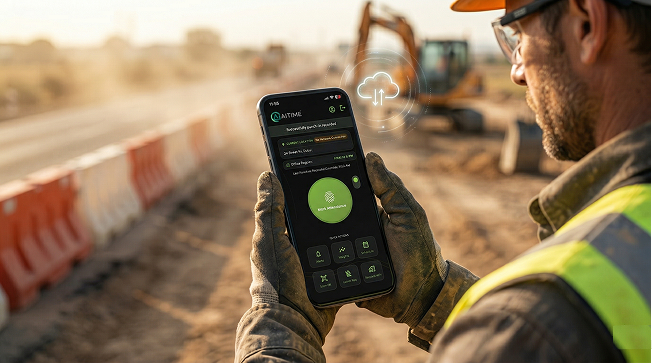
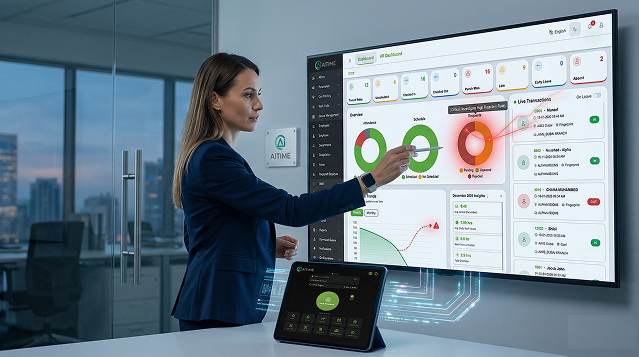
Once identity is confirmed, the system automatically creates a timestamped attendance event: employee ID, date, time, and device location. This data flows in real time (or in batches when offline) to the AiTIME cloud platform, where it is processed against the employee's assigned shift schedule, applied leave requests, and overtime rules. HR managers can view live attendance dashboards from any browser or the mobile app without needing to be on site.
Key Benefits for UAE Businesses
Elimination of Buddy Punching
In a workforce where employees may work overlapping shifts or on crowded sites, buddy punching — where one employee clocks in for another — is a persistent source of payroll fraud. Face recognition makes this physically impossible. Every clock-in event is tied to the person who is physically present. According to industry estimates, buddy punching costs businesses between 2% and 5% of their total payroll; for a UAE company with 200 employees, that is tens of thousands of dirhams lost annually. The AiTIME attendance tracker eliminates this loss entirely.
Contactless and Hygienic Operation
Fingerprint scanners require physical contact with a shared surface. In a post-pandemic world — and especially in healthcare, food service, and hospitality settings — this is a hygiene concern. Face recognition requires no contact whatsoever. Employees simply walk past the camera and their attendance is logged. This is a particularly strong advantage in UAE healthcare facilities and restaurants where hygiene standards are closely monitored.
Speed and Throughput
At shift change in a large facility, hundreds of employees may need to clock in within a 10–15 minute window. A fingerprint reader processes roughly 3–5 employees per minute. A face recognition terminal with wide-angle detection can process 15–30 employees per minute, eliminating queue-forming at entry points — a common complaint on large UAE construction and manufacturing sites.
No Tokens to Manage
Cards get lost. PINs get forgotten. Employees get locked out at the worst possible moments. With face recognition, the employee's face is their credential — it is always with them, always ready, and cannot be left at home. This is especially valuable in UAE industries with high employee turnover, such as hospitality and retail, where issuing and deactivating access credentials is an ongoing administrative burden.
Integration with Payroll
The real power of face recognition attendance is not just in the clocking — it is in what happens next. AiTIME's face recognition attendance system connects directly to payroll processing. Every clock-in and clock-out event is automatically matched against the employee's shift schedule. Late arrivals, early departures, overtime hours, and absent days are all calculated automatically. At payroll run time, the system generates a WPS-ready salary file that can be submitted directly to the bank — no manual data entry, no spreadsheet reconciliation, no errors.
For UAE businesses, this WPS integration is critical. The UAE Ministry of Human Resources and Emiratisation mandates that private sector companies with 10 or more employees pay salaries through the Wages Protection System. Non-compliance carries severe penalties, including business licence suspension. AiTIME ensures every payroll cycle is fully WPS-compliant.
Common Questions from UAE HR Managers
Does the system work outdoors in UAE heat and bright sunlight?
Yes — with the right hardware. Standard consumer-grade cameras struggle in direct bright light. AiTIME recommends and supports ZKTeco devices with infrared illumination and specialised outdoor-rated enclosures. These devices are designed to operate in temperatures up to 55°C and in direct sunlight, making them suitable for UAE construction sites, outdoor facilities, and uncovered car parks.
What about employees wearing masks or religious face coverings?
Modern face recognition algorithms have been specifically trained on partially occluded faces. Most current-generation devices achieve above 95% accuracy on employees wearing standard surgical or cloth masks. For employees wearing a full niqab, an alternative enrolment option — such as fingerprint or employee PIN as a secondary factor — can be configured without disrupting the broader system.
Is biometric data safe and private?
UAE data protection regulations, including Federal Decree-Law No. 45 of 2021 on Personal Data Protection (PDPL), classify biometric data as sensitive personal data requiring appropriate safeguards. AiTIME stores only the mathematical faceprint — not a recognisable image — in encrypted form on servers hosted in the UAE. Data is never shared with third parties without consent. Businesses should ensure their employment contracts and onboarding documentation include explicit biometric data consent as required by the PDPL.
What is the accuracy rate?
Under controlled indoor conditions, leading algorithms achieve false acceptance rates (FAR) below 0.001% — meaning fewer than 1 in 100,000 comparisons incorrectly confirms an identity. In real-world UAE deployments, AiTIME clients typically report accuracy rates above 99.5% after a brief tuning period post-installation.
Is Face Recognition Right for Your Business?
Face recognition attendance is an excellent fit for most UAE businesses with 10 or more employees. It is particularly compelling for organisations with multiple shifts, high headcounts, hygiene-sensitive environments, or a history of buddy-punching issues. Smaller businesses can also benefit, especially when the payroll integration saves significant HR staff time each month.
If you are evaluating options, the AiTIME attendance tracker comparison guide can help you understand how different technologies stack up for your specific industry and workforce size.
Get Started with AiTIME Face Recognition Attendance
AiTIME delivers end-to-end face recognition attendance for UAE businesses — hardware supply and installation, cloud software setup, payroll integration, and ongoing local support. We serve clients across Dubai, Abu Dhabi, Sharjah, and across all GCC countries.
Book your free AiTIME demo today and see how face recognition attendance can transform your HR operations, eliminate payroll fraud, and keep your business fully compliant with UAE labour law.
HR Technology & Workforce Management Specialists
The AiTIME editorial team comprises HR technology specialists and workforce management experts with deep knowledge of UAE Labour Law, WPS payroll compliance, biometric attendance systems, and GCC business operations. AiTIME serves 500+ businesses across UAE, Saudi Arabia, Qatar, Kuwait, Bahrain, and Oman.
Ready to Transform Your Workforce Management?
Join 500+ businesses using AiTIME for attendance tracking, shift scheduling, and HR analytics.